Hedgewood School
Be nice. Work hard. Be happy
Reading and Phonics
Our commitment is to give every pupil the ability to read and comprehend the world around them—from symbols and pictures to the written word. We ensure the teaching of reading at our school is of the highest quality.
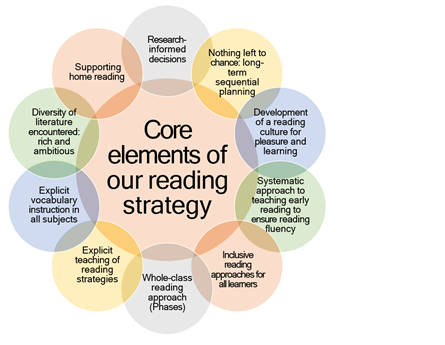
Our overall reading strategy is built around nine core elements that are implemented effectively and constantly monitored. By ensuring that each of these areas is successful, we guarantee a high-quality, rich reading experience for all pupils.
Systematic Synthetic Phonics (SSP)
BugClub Phonics Programme
Hedgewood School uses BugClub Phonics, a DfE approved scheme that aligns with the structure of the Letters and Sounds programme. This ensures a comprehensive, step-by-step approach to teaching the basic 40+ phonemes quickly and effectively. Decodable readers are introduced after just 10 days of teaching time to develop early reading skills rapidly.
We track each child's progress using the Hedgewood Phonics Tracker, which follows the Letters and Sounds phases, ensuring instruction is always targeted and precise.
Our Phonics Progression:
|
Phonics phase |
Focus and Intent |
|
Pre-Phase 1 |
The essential foundational stage for pupils not yet ready for sound-to-symbol correspondence. Focuses on developing sensory skills and the earliest points of communication needed to handle phonemes later on. See example of our Pre-phase 1 tracker |
|
Phase 1 |
Developing Early Phonological Awareness, building on foundational skills by concentrating on listening, attention, sound discrimination, rhythm, rhyme, and alliteration. |
|
Phase 2 |
Introduces the first letter-sound correspondences, where children begin blending sounds to read simple words and segmenting words to spell. |
|
Phase 3 |
Extends knowledge by introducing digraphs (two letters, one sound) and trigraphs (three letters, one sound), alongside high-frequency 'tricky' words. |
|
Phase 4 |
Consolidation of previous learning. Pupils focus on blending and segmenting longer, multi-syllable words and applying skills for greater fluency and accuracy. |
|
Phase 5 |
Introduces alternative graphemes for known phonemes and new pronunciations, expanding pupils' ability to decode and spell a wider range of words for greater independence. |
Developing Skilled Reading and Comprehension
We understand reading as a two-part skill, often illustrated by Scarborough's Reading Rope: Reading = Language Comprehension + Decoding. Understanding that our pupils benefit from targeted work on each component, we consider profiles of reading abilities based on language comprehension and word recognition.

Language Comprehension (The Top Strand)
This is the broad ability to understand spoken language—built through rich vocabulary, grammar, background knowledge, and inference.
- Shared Story Reading is a high-impact strategy, exposing children to complex grammar and narrative structures.
- We use Dialogic Reading (PEER & CROWD strategies) to turn storytime into an interactive conversation, promoting deep engagement.
- PEER: Prompt, Evaluate, Expand, Repeat.
- CROWD: Completion, Recall, Open-ended, Wh questions, Distancing.
- Comprehension is embedded in functional and recreational activities using a cross-curricular approach, developing concepts through visuals in all lessons.
Decoding (The Bottom Strand)
This is the ability to sound out written words, built through phonics, phonological awareness, and repeated practice.
- Systematic Synthetic Phonics (SSP) is taught daily for pupils ready for sound-to-symbol correspondence.
- Pupils read from books with the sounds they know, utilising Bug Club, Floppy Phonics, Project X, and Oxford Reading Tree schemes.
- Pupils are encouraged to apply their phonic knowledge in independent work, guided writing, and reading sessions.
Personalised Implementation & Total Communication
For our pupils, we ensure our approach is highly personalised, aligning with each pupil's cognitive development and specific area of need.
Total Communication
We are dedicated to ensuring every pupil has an effective, functional voice through our 'Speaker Initiative', which utilises a Total Communication approach (including signs, symbols, and aids). This core focus ensures each child's preferred method of communication adheres to the C.A.F.É. criteria (Continuously Available, Frequently used, and Effortless) to reduce frustration and promote engagement.
Key Implementation Points:
- Communication-Rich Environment: We foster language development through communication-rich environments, including visual strategies like Picture Exchange, Social Stories, and 'Now and Next' boards, promoting speaking and listening/oracy throughout the school day.
- Functional Reading Skills: Pupils are supported in the functional reading of real-world texts, such as recipes, instructions, shopping lists, menus, shop signs, and vocational instructions, to build independence and life skills.
- Highly Personalised Learning: English and reading activities are often based on highly favoured and relevant topics for each individual pupil.
Enrichment and Home Partnership
Reading is championed across the school and is supported by a rich tapestry of activities and home-school partnerships:
Enrichment Activities:
- School Library use and Community Library visits.
- Reading lunchtime clubs linked with drama and performance sessions.
- Daily song and rhyme activities, and music lessons to support listening and sound matching.
- Fostering a love of literature across all pathways through daily storytelling and shared book activities.
- Updated classroom books and dedicated reading areas in common spaces.
- Pupils making their own stories for the school library.
- Storytelling visitors and stories in assemblies.