Hedgewood School
Be nice. Work hard. Be happy
Writing
We view the development of writing as a ladder that must be climbed step-by-step, following a child’s natural development to ensure success and prevent anxiety.
We believe that teaching writing before a child is developmentally ready can actually slow down their progress. Instead of rushing into letter formation, we focus on providing play opportunities where children can naturally develop pre-requisite skills. Skipping foundational steps like pre-writing shapes and patterns can lead to distress and a reluctance to engage in writing later on.
Writing is always linked to comprehension and functional communication. Our curriculum balances Transcription (the mechanics of spelling and handwriting) with Composition (the meaning and expression of ideas.)
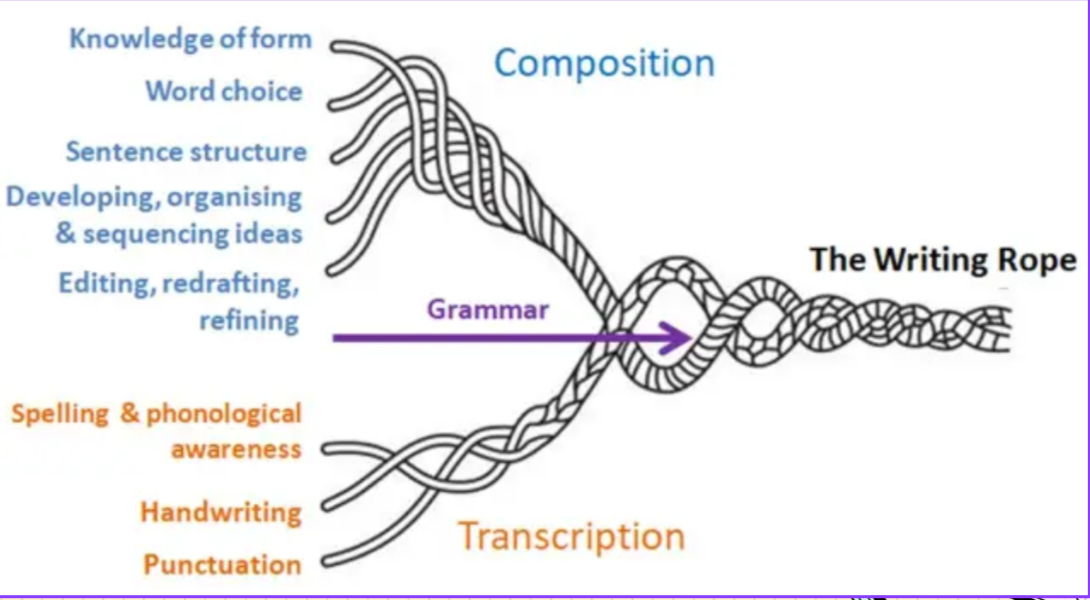 |
The writing rope
Writing is a complex task that requires the integration of several skills:
- Gross Motor & Postural Control: Strength in the arms and shoulders is essential to stabilise the hand for fine motor tasks. Core stability and trunk support allow a child to maintain their posture and balance while writing.
- Sensorimotor & Perceptual Processing: This includes tactile perception (feedback from the pencil/paper), kinesthetic perception (awareness of body movement), and visual perception (the ability to recognise shapes and patterns).
- Cognitive Skills: Success depends on attention to stay on task, memory to recall letter formations, and sequencing to order letters into words.
- Psychosocial Factors: A child’s emotional stability, self-esteem, and motivation are critical; they must feel confident enough to try and accept making mistakes.
Purposeful and Motivating Writing
To keep pupils engaged, we strive to make writing meaningful. This includes:
- Writing for real purposes, such as shopping lists, birthday cards, or invitations.
- Playing word games like Hangman to build spelling confidence.
- using writing prompts that focus on personal interests or class topics.